


Introduction
Technical debt, the silent killer of startup agility, is more than just messy code. It's the implied cost of rework caused by choosing an easy solution now instead of a better approach that would take longer. For a startup CTO, ignoring it is like borrowing from a lender with compounding interest that can cripple your growth. A McKinsey & Company report warns that technical debt can swallow up to 40% of a company's technology estate value, a staggering figure that directly translates to slower feature releases, decreased developer morale, and a compromised ability to innovate. Effective technical debt management is not a luxury; it's a necessity.
This playbook is designed for the fast-paced startup environment. It's not about achieving a mythical "zero-debt" state but about creating a practical, sustainable framework to manage and tame this ever-present challenge. You will learn how to move from vague "code smells" to a concrete, data-driven understanding of your debt, prioritize what to fix, and weave repayment seamlessly into your development sprints. By the end of this startup CTO guide, you'll be equipped to transform technical debt from a source of drag into a strategic lever for building a resilient, scalable, and ultimately more valuable product.
From Code Smell to Hard Numbers: How to Measure Technical Debt
For many CTOs, technical debt feels like an invisible force—you can sense its effects, but you can't quite pin it down. It manifests as features that take longer to ship, a rise in unpredictable bugs, and a palpable sense of friction in the development process. However, to effectively manage technical debt, you must first move beyond these "code smells" and learn how to measure technical debt in concrete terms. Without hard numbers, you're flying blind, unable to make a compelling case to stakeholders or strategically prioritize your team's efforts.
The first step is to create a comprehensive inventory of your existing debt. This requires a multi-faceted approach that combines automated analysis with qualitative feedback from the people who know the codebase best: your developers.
1. Leverage Static Code Analysis Tools
Modern development platforms offer a suite of tools that can automatically scan your codebase to identify and measure technical debt. Tools like SonarQube, CodeScene, and Stepsize are invaluable for establishing a baseline. They analyze various aspects of your code, such as:
- Code Complexity: Measured by metrics like Cyclomatic Complexity, which indicates the number of independent paths through a piece of code. Higher complexity often correlates with a higher likelihood of defects and increased maintenance effort.
- Duplication: Identifies redundant code blocks that can make the system harder to understand and modify. A change in one place may require identical changes elsewhere, increasing the risk of introducing errors.
- Code Smells: These are patterns in the code that suggest a deeper problem. While not bugs themselves, they are indicators of design flaws that can lead to issues down the line.
By integrating these tools into your CI/CD pipeline, you can get a continuous, real-time assessment of your codebase's health. This allows you to track trends over time and catch new debt before it accumulates.
2. Gather Qualitative Insights from Your Team
While automated tools provide the "what," your development team can provide the crucial "why." Developers are on the front lines and have a deep, intuitive understanding of which parts of the system are brittle, difficult to work with, or actively slowing them down.
One effective method for capturing this knowledge is to conduct a Technical Debt Survey. Ask your engineers to identify:
- The top three areas of the codebase that are most challenging to work on.
- The components they believe are most in need of refactoring.
- Any architectural decisions that are causing significant bottlenecks.
This qualitative data is incredibly valuable. It helps you understand the human impact of technical debt—such as decreased morale and developer productivity—and provides context that raw metrics alone cannot. As noted by CTO Magazine, blending engineering and product metrics with this kind of direct feedback is crucial for effective management.
3. Analyze Performance and Business Metrics
Technical debt doesn't just impact your codebase; it has real-world consequences for your product and your users. Correlating technical issues with business outcomes is a powerful way to quantify their impact and understand their business value. Look for connections between:
- High-Debt Modules and Bug Reports: Are certain parts of your application responsible for a disproportionate number of customer-reported issues?
- -
- System Performance and User Engagement:
- Do slow-loading pages or frequent timeouts correlate with a drop in user activity or conversion rates? -
- Development Lead Time and Feature Complexity:
- How much longer does it take to implement a new feature in a debt-ridden area of the code versus a clean one?
By connecting the dots between code quality and business performance, you can translate abstract technical problems into a language that the entire organization can understand. This is the key to moving technical debt from a purely technical concern to a strategic business conversation.
The Prioritization Matrix: A Startup's Guide to Prioritize Technical Debt
Once you have a quantified inventory of your technical debt, the next challenge is to prioritize technical debt. In a startup, resources are always constrained, and you can't afford to tackle everything at once. Attempting to do so will likely result in a scattered effort that fails to make a meaningful impact. The key is to be strategic and ruthless in your prioritization.
This is where the technical debt impact vs. effort matrix comes in. It's a simple yet powerful tool that helps you categorize technical debt items and make data-informed decisions about what to address. The matrix is divided into four quadrants based on two key dimensions:
- Impact: What is the business impact of this piece of technical debt? Does it affect a critical user-facing feature? Is it a source of frequent production issues? Does it significantly slow down the development of new features?
- Effort: How much work is required to fix it? Is it a quick refactor that can be handled by a single developer in a day, or is it a major architectural overhaul that will require a dedicated team and several sprints?
By plotting each item from your technical debt inventory onto this matrix, you can develop a clear action plan.
1. High Impact, Low Effort: The Quick Wins
This is the low-hanging fruit. These are the issues that are causing significant pain but are relatively easy to fix. Addressing them provides a quick and visible return on investment, which can be a great way to build momentum and demonstrate the value of tackling technical debt.
- Examples: Fixing a recurring bug in a core feature, refactoring a confusing module that is frequently touched by developers, or optimizing a slow-running database query.
- Action: Tackle these immediately. These should be your top priority. They offer the best bang for your buck and can help free up your team to focus on more complex challenges.
2. High Impact, High Effort: The Major Projects
These are the big, hairy problems that are often deeply embedded in your system's architecture. They have a significant negative impact on your business, but they also require a substantial investment of time and resources to fix.
- Examples: Migrating from a legacy monolithic architecture to microservices, upgrading a core framework to a new major version, or rebuilding a critical component from the ground up.
- Action: Schedule these strategically. These are major projects that need to be planned and budgeted for. Break them down into smaller, manageable chunks and incorporate them into your product roadmap. As a guide from InfoQ suggests, it's often best to align these large-scale efforts with broader business objectives.
3. Low Impact, Low Effort: The Fill-in Tasks
These are the minor annoyances and "nice-to-have" fixes. They don't have a major impact on your business, but they're also easy to address.
- Examples: Cleaning up inconsistent code formatting, improving documentation, or refactoring a minor internal tool.
- Action: Address these when you have downtime. These are great tasks for new team members to get familiar with the codebase or for developers to pick up between larger projects. Don't let them clog up your main backlog, but don't ignore them completely either.
4. Low Impact, High Effort: The Time Sinks
These are the issues that you should, in most cases, learn to live with. They are complex and time-consuming to fix, but they don't have a significant negative impact on your business.
- Examples: Refactoring a rarely used legacy feature, migrating a non-critical system to a new technology stack just for the sake of modernization, or striving for "perfect" code in a low-traffic part of the application.
- Action: Safely ignore these (for now). In a startup, your resources are too valuable to be spent on low-impact, high-effort tasks. Keep them on a "someday/maybe" list, but be realistic about the fact that you may never get to them—and that's okay.
By using this matrix, you can move from a reactive, "firefighting" approach to a proactive, strategic one. It allows you to have a clear, defensible rationale for your decisions and to communicate your plan effectively to both your team and your stakeholders.
Strategic Repayment: Weaving Agile Technical Debt Management into Sprints
Identifying and prioritizing technical debt is a critical first step, but it's meaningless without a plan for repayment. In a startup, the pressure to deliver new features is relentless, and it can be tempting to push technical debt work to the back burner indefinitely. This is a trap. To build a sustainable and scalable product, you must make debt repayment a regular, predictable part of your development lifecycle, especially when following agile methodologies.
The key to agile technical debt management is to move away from the idea of a "technical debt sprint"—a dedicated period where all feature development stops. While this can be useful in emergencies, it's not a sustainable long-term strategy. Instead, you should aim to weave debt management into the fabric of your regular sprints.
1. Allocate a Fixed Percentage of Sprint Capacity
One of the most effective and widely adopted strategies is to dedicate a fixed percentage of each sprint to technical debt repayment. This is often referred to as the "20% rule," although the exact percentage can be adjusted to fit your team's specific context. A common range is between 15-25% of your sprint's story points or hours.
This approach has several advantages:
- Consistency: It ensures that you are continuously making progress on reducing your debt, rather than letting it pile up.
- Predictability: It makes your velocity more predictable, as you are accounting for this work in your sprint planning.
- Flexibility: It allows you to tackle a mix of small and medium-sized debt items without derailing your product roadmap.
As suggested by Atlassian's guide to agile development, this consistent approach helps prevent a decline in code quality and delivery delays over the long term.
2. The "Boy Scout Rule": Leave the Code Better Than You Found It
Another powerful practice is to adopt the "Boy Scout Rule," which states that you should always leave the code a little cleaner than you found it. This means that whenever a developer is working on a new feature or fixing a bug, they should also take a little extra time to clean up the surrounding code.
This could involve:
- Renaming a poorly named variable to make it more intuitive.
- Breaking down a long, complex function into smaller, more manageable ones.
- Adding a few comments to clarify a particularly tricky piece of logic.
This approach is highly effective because it distributes the work of debt repayment across the entire team and integrates it directly into their existing workflow. It prevents the accumulation of new "small" debts and contributes to a gradual improvement in the overall health of your codebase.
3. Communicating Technical Debt to Stakeholders
One of the biggest hurdles to effectively managing technical debt is getting buy-in from non-technical stakeholders. It's not enough to say, "We need to refactor the user authentication module." You need to translate that technical task into a clear business benefit. This is a core part of communicating technical debt to stakeholders.
Instead of talking about "refactoring," talk about:
- "Improving the user login experience to reduce customer support tickets by 15%."
- -
- "Increasing the speed of future feature development in the user profile section, allowing us to ship the new social sharing features a sprint earlier."
- -
- "Reducing the risk of a security vulnerability in our payment processing system."
As a Medium article on the topic astutely points out, you need to "translate technical debt into stories that resonate with business goals." By framing the conversation in terms of business value, you can transform technical debt from a niche engineering concern into a strategic priority that everyone can get behind.
By combining these strategies, you can create a sustainable system for technical debt management that doesn't require you to sacrifice innovation. You can continue to move fast and build new things, all while ensuring that you are building on a solid, scalable foundation.
Conclusion
For a startup CTO, technical debt is not a sign of failure; it's an inevitable consequence of the speed and agility required to innovate and compete. The difference between a startup that thrives and one that gets bogged down in its own complexity lies not in the absence of technical debt, but in the strategic management of it. Taming technical debt is not about reaching an unattainable state of perfection, but about creating a sustainable system for controlled, intentional growth.
This playbook has provided a three-step framework for transforming technical debt from a source of friction into a manageable part of your development process:
- Quantify Your Debt: Move beyond vague "code smells" to a concrete, data-driven understanding of your technical debt. By leveraging code analysis tools, gathering qualitative feedback from your team, and connecting technical issues to business metrics, you can create a clear and compelling case for action.
- Prioritize Ruthlessly: You can't fix everything at once. Use the Impact vs. Effort matrix to categorize your debt and focus your resources where they will have the greatest effect. Tackle the high-impact, low-effort "quick wins" immediately, strategically schedule the high-impact, high-effort "major projects," and have the discipline to ignore the rest.
- Integrate Repayment into Your Sprints: Make technical debt repayment a regular, predictable part of your development lifecycle. By allocating a fixed percentage of your sprint capacity and empowering your team to "leave the code better than they found it," you can create a virtuous cycle of continuous improvement.
By adopting this playbook for technical debt management, you can build a more resilient, scalable, and ultimately more valuable product. You can empower your team to not only ship features quickly but also to build a foundation that will support your company's growth for years to come. The goal is not to eliminate technical debt but to tame it—to make it a conscious choice rather than a silent killer.
Related Articles

System Design Interview: The Ultimate Guide to Acing Your FAANG Interview in 2025
Demystifying the System Design Interview: What to Expect in a FAANG Interview Before diving into complex architectural patterns, it's crucial to understand the fundamentals of the system design interview (SDI). This chapter lays the groundwork, defining what these interviews entail at FAANG and other top-tier tech companies, their unique challenges, and the key evaluation criteria used to assess candidates in 2025. A system design interview is a high-level technical discussion where you're ask
Read More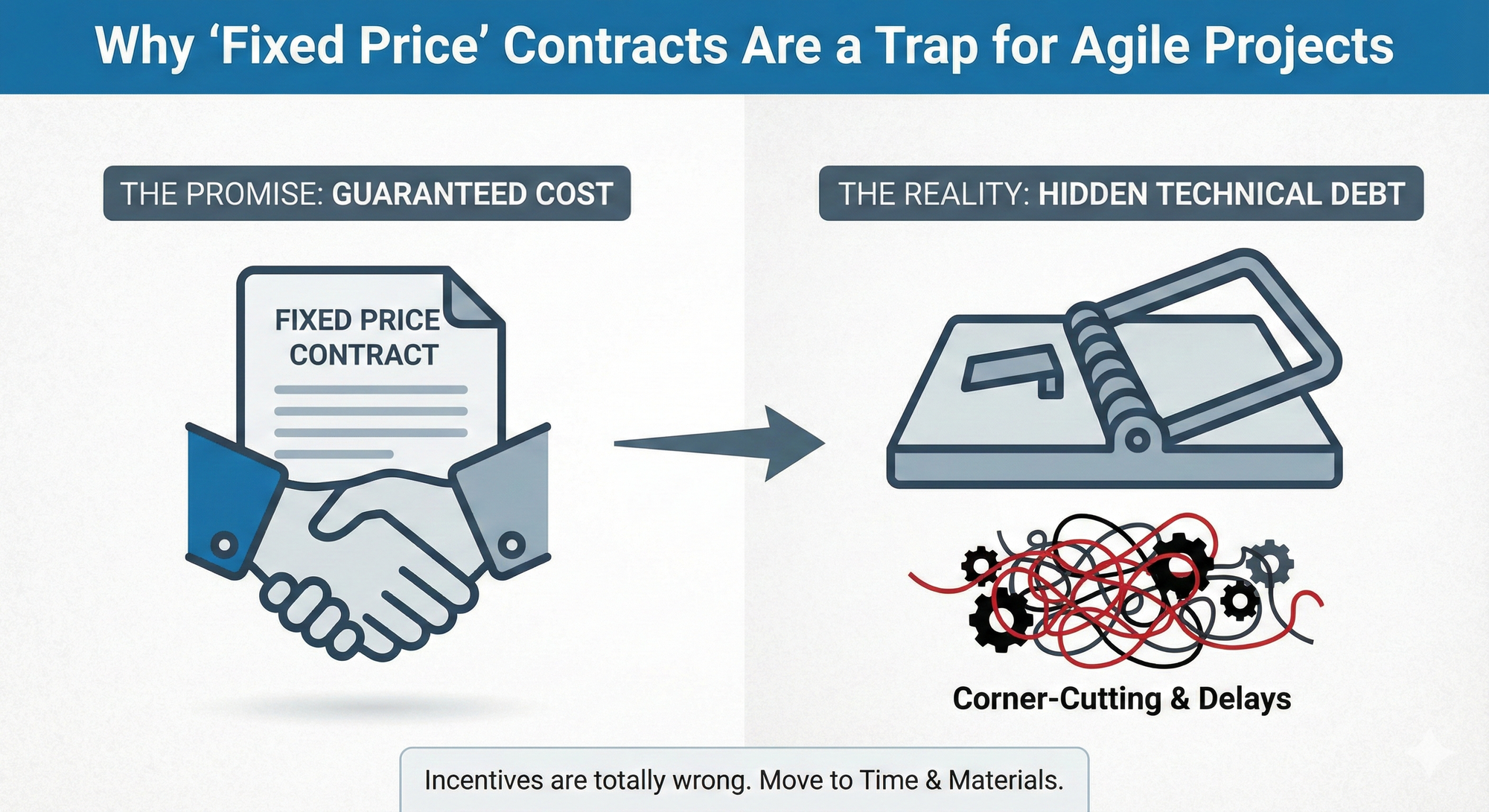
The "Fixed Price" Mirage: Why You’re Buying Technical Debt, Not Certainty
Your CFO loves fixed-price contracts. They fit perfectly into a Q3 budget spreadsheet. You know exactly what you are spending. You have a signed piece of paper promising a specific set of features on a specific date. It feels safe. It is actually the riskiest way to build software. In agile development, a fixed-price bid is a lie agreed upon by both parties. You pretend requirements won't change. The vendor pretends they know exactly how long complex engineering tasks will take. When reality
Read More
The High Cost of Cheap Code: Why Your "Frankenstein" Codebase is Unmaintainable
You look at your product’s codebase and you don’t recognize it. It was built quickly. You hired three different top-rated freelancers from a popular platform over the last year. They were affordable and available immediately. At first, features shipped fast. Now, development has ground to a halt. Your codebase has become a graveyard of half-finished ideas and conflicting architectural styles. It is a "Frankenstein" product—cobbled together with no central nervous system. This isn't bad luck
Read More