


How to Scale Engineering Leadership Without the C-Suite Price Tag
You have a vision. You have a budget. You might even have a few talented freelance developers. But six months in, you hit a wall. Features are delayed, the app is crashing under load, and your developers are waiting days for answers to complex architectural questions.
You don’t have a coding problem; you have a leadership problem.
For many startups and SMEs, hiring a full-time Chief Technology Officer (CTO) with a six-figure salary and equity package is financially impossible. Yet, proceeding without one is a recipe for technical debt.
Enter the Fractional CTO.
What is a Fractional CTO?
A Fractional CTO is a veteran technology executive who partners with your company on a part-time or retainer basis. Unlike a freelancer who focuses on tasks (writing code), a Fractional CTO focuses on strategy (building the roadmap).
They provide the high-level guidance of a C-level executive for a fraction of the cost, typically dedicating 5–10 hours a week to your project.
3 Signs You Need Fractional Leadership
- The "Senior Dev" Trap: You are relying on your best coder to make business decisions. While they are great at Python or React, they may lack the experience to align technical choices with your 2-year business goals.
- Hiring Misses: You struggle to vet talent. You’ve hired developers who looked good on paper but couldn’t deliver, costing you months of runway.
- Scalability Scares: You are worried that the MVP code built today won't handle tomorrow's users.
The Smart Maple Difference: Strategy Meets Execution
At Smart Maple, we believe that leadership shouldn't be decoupled from execution.
Most agencies send you a list of developers and wish you luck. We operate differently. We can pair our vetted offshore engineering teams with a Fractional Engineering Manager or CTO.
This means you get the best of both worlds:
- Cost Efficiency: Affordable, high-performance remote developers executing the daily work.
- Executive Oversight: A seasoned leader ensuring the architecture is sound, the code is clean, and the project hits its milestones.
Don't let a lack of leadership stall your growth. You can build enterprise-grade software without the enterprise-grade overhead.
Ready to professionalize your development process? Contact Smart Maple today to discuss our fractional leadership packages.
Related Articles

Technical Debt Management: A Startup CTO's Playbook for 2026
Introduction Technical debt, the silent killer of startup agility, is more than just messy code. It's the implied cost of rework caused by choosing an easy solution now instead of a better approach that would take longer. For a startup CTO, ignoring it is like borrowing from a lender with compounding interest that can cripple your growth. A McKinsey & Company report warns that technical debt can swallow up to 40% of a company's technology estate value, a staggering figure that directly translat
Read More
System Design Interview: The Ultimate Guide to Acing Your FAANG Interview in 2025
Demystifying the System Design Interview: What to Expect in a FAANG Interview Before diving into complex architectural patterns, it's crucial to understand the fundamentals of the system design interview (SDI). This chapter lays the groundwork, defining what these interviews entail at FAANG and other top-tier tech companies, their unique challenges, and the key evaluation criteria used to assess candidates in 2025. A system design interview is a high-level technical discussion where you're ask
Read More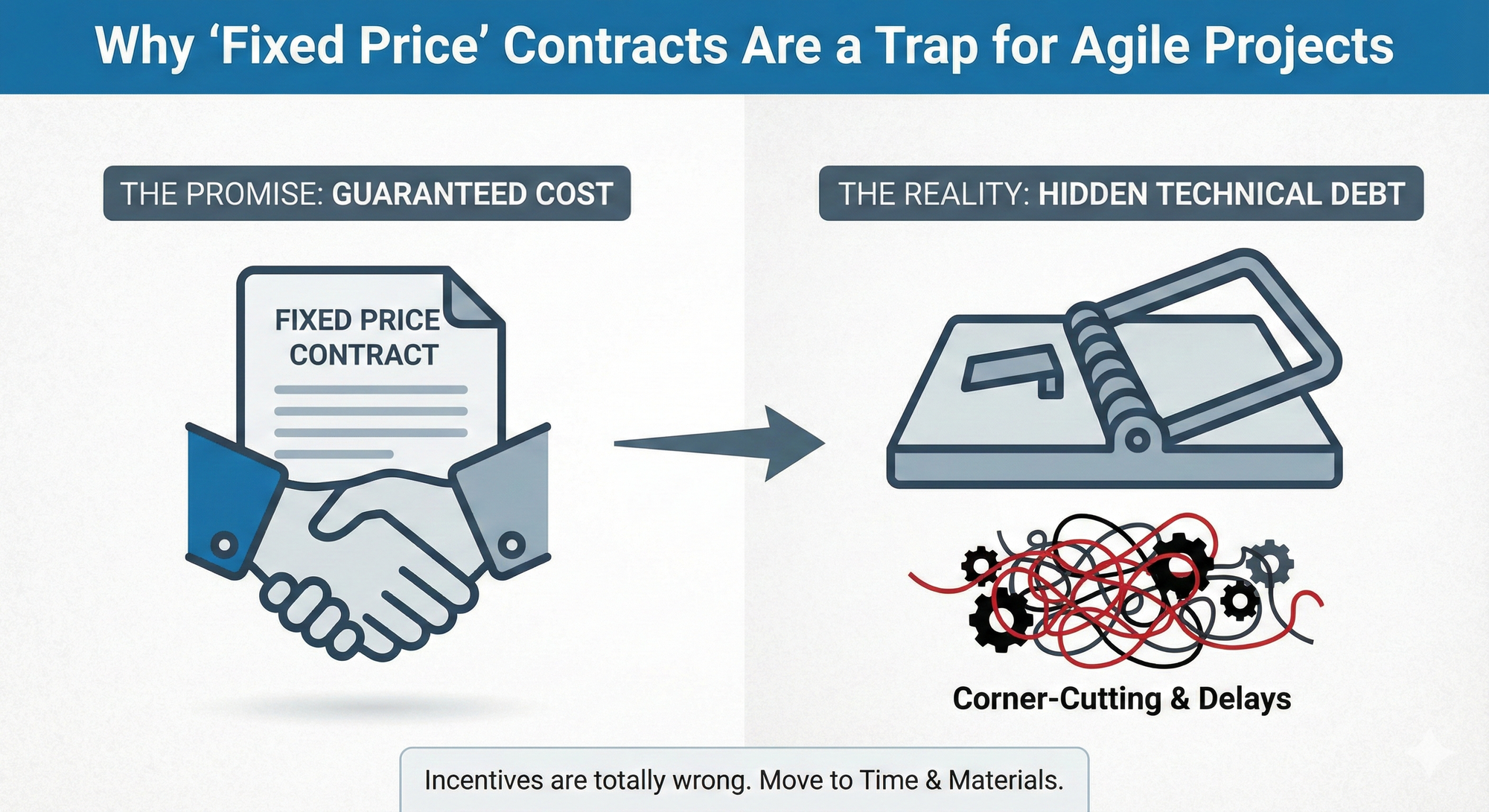
The "Fixed Price" Mirage: Why You’re Buying Technical Debt, Not Certainty
Your CFO loves fixed-price contracts. They fit perfectly into a Q3 budget spreadsheet. You know exactly what you are spending. You have a signed piece of paper promising a specific set of features on a specific date. It feels safe. It is actually the riskiest way to build software. In agile development, a fixed-price bid is a lie agreed upon by both parties. You pretend requirements won't change. The vendor pretends they know exactly how long complex engineering tasks will take. When reality
Read More