


Scheduling breaks when it starts with guesswork.
Healthcare teams feel this every week.
Hospitals need schedules that respect rest rules, balance shifts, and still cover every department. Managers need something simple. Staff need something fair. Most tools fail at one of those.
We built Oplist to fix that.
Our team delivered a multi-tenant React, Node.js, and PostgreSQL platform on AWS that generates compliant schedules in minutes. It accounts for post-shift rest, department targets, role limits, and approvals. Managers get clear distribution options. Staff get predictable rotations. Leadership gets organization-wide visibility.
A few details that matter
- Auto-generated shift plans with built-in rest logic
- Balanced or uniform distribution by department
- Role-based admin with approvals and audit trails
- Staff notifications and ready-to-export schedules
- CI/CD-backed architecture built for growth
The result is simple: less time building schedules, more time running the hospital, and a fairer system for everyone.
If you're exploring similar operational tools, we can walk you through the architecture.
Related Articles

Technical Debt Management: A Startup CTO's Playbook for 2026
Introduction Technical debt, the silent killer of startup agility, is more than just messy code. It's the implied cost of rework caused by choosing an easy solution now instead of a better approach that would take longer. For a startup CTO, ignoring it is like borrowing from a lender with compounding interest that can cripple your growth. A McKinsey & Company report warns that technical debt can swallow up to 40% of a company's technology estate value, a staggering figure that directly translat
Read More
System Design Interview: The Ultimate Guide to Acing Your FAANG Interview in 2025
Demystifying the System Design Interview: What to Expect in a FAANG Interview Before diving into complex architectural patterns, it's crucial to understand the fundamentals of the system design interview (SDI). This chapter lays the groundwork, defining what these interviews entail at FAANG and other top-tier tech companies, their unique challenges, and the key evaluation criteria used to assess candidates in 2025. A system design interview is a high-level technical discussion where you're ask
Read More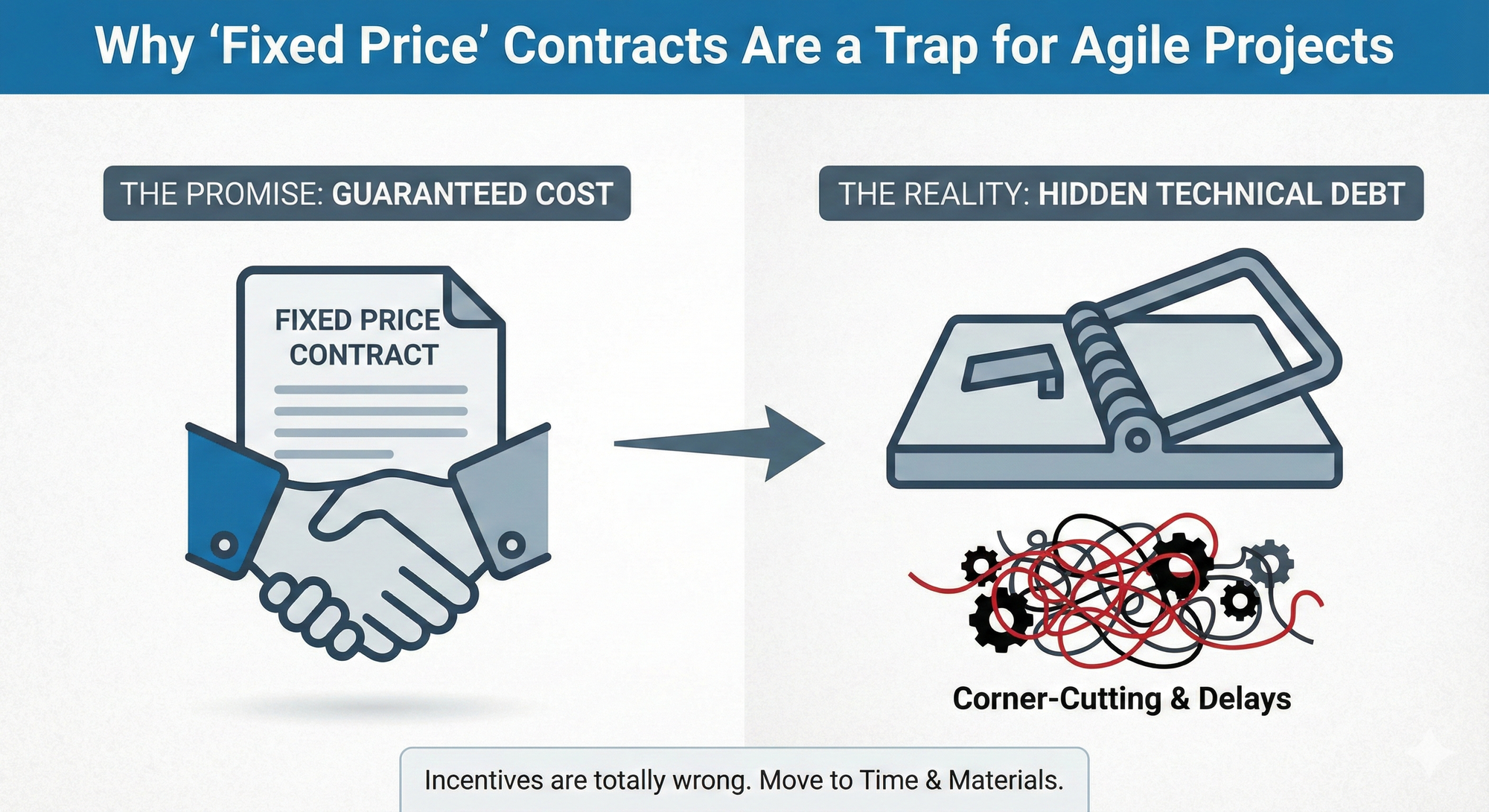
The "Fixed Price" Mirage: Why You’re Buying Technical Debt, Not Certainty
Your CFO loves fixed-price contracts. They fit perfectly into a Q3 budget spreadsheet. You know exactly what you are spending. You have a signed piece of paper promising a specific set of features on a specific date. It feels safe. It is actually the riskiest way to build software. In agile development, a fixed-price bid is a lie agreed upon by both parties. You pretend requirements won't change. The vendor pretends they know exactly how long complex engineering tasks will take. When reality
Read More