


For early-stage startups, the allure of serverless architecture (like AWS Lambda) is undeniable. It promises a frictionless entry into the market: zero upfront server costs, infinite scalability, and the seductive mantra of "pay only for what you use." For a founder watching their burn rate, it feels like the perfect financial safety net. But as many growing SaaS companies discover too late, that safety net can quickly turn into a financial trap.
The Scale Trap
The pain point usually hits when a startup achieves its first major milestone: meaningful scale. A feature that worked cheaply in testing—perhaps a background data syncing job or an image processing trigger—suddenly starts firing millions of times a month. Because serverless billing is based on invocations and execution duration, a slight inefficiency in your code multiplied by heavy traffic leads to an exponential bill explosion. We have seen startups where the cloud bill jumped 500% in a single month, not because their revenue grew 500%, but because their architecture wasn't designed for high-volume throughput.
Beyond the Bill: The Performance Tax
The cost isn't just monetary; it's operational. Serverless introduces "cold starts"—the latency that occurs when a function wakes up to handle a request. For a high-value user experience, waiting 2 seconds for a dashboard to load is unacceptable. Furthermore, debugging a distributed web of serverless functions is like solving a murder mystery with no witnesses. The complexity of monitoring and tracing errors across hundreds of ephemeral functions requires expensive tools and highly specialized engineering hours—resources that could be better spent on product development.
The Smart Maple Approach: ROI Over Hype
At Smart Maple, we don't blindly follow technology trends; we prioritize your ROI. While we love serverless for event-driven tasks and sporadic workloads, we know that for consistent, high-load applications, a containerized approach (using Docker and Kubernetes) or even a well-architected monolith is often far more cost-effective. These predictable, flat-rate architectures allow you to scale your business without the anxiety of an unpredictable bill.
Proficient engineering isn't just about writing code; it's about choosing the right architecture for your business stage. If you are worried your infrastructure costs are outpacing your growth, our vetted experts and fractional engineering managers can help you regain control.
Related Articles

Technical Debt Management: A Startup CTO's Playbook for 2026
Introduction Technical debt, the silent killer of startup agility, is more than just messy code. It's the implied cost of rework caused by choosing an easy solution now instead of a better approach that would take longer. For a startup CTO, ignoring it is like borrowing from a lender with compounding interest that can cripple your growth. A McKinsey & Company report warns that technical debt can swallow up to 40% of a company's technology estate value, a staggering figure that directly translat
Read More
System Design Interview: The Ultimate Guide to Acing Your FAANG Interview in 2025
Demystifying the System Design Interview: What to Expect in a FAANG Interview Before diving into complex architectural patterns, it's crucial to understand the fundamentals of the system design interview (SDI). This chapter lays the groundwork, defining what these interviews entail at FAANG and other top-tier tech companies, their unique challenges, and the key evaluation criteria used to assess candidates in 2025. A system design interview is a high-level technical discussion where you're ask
Read More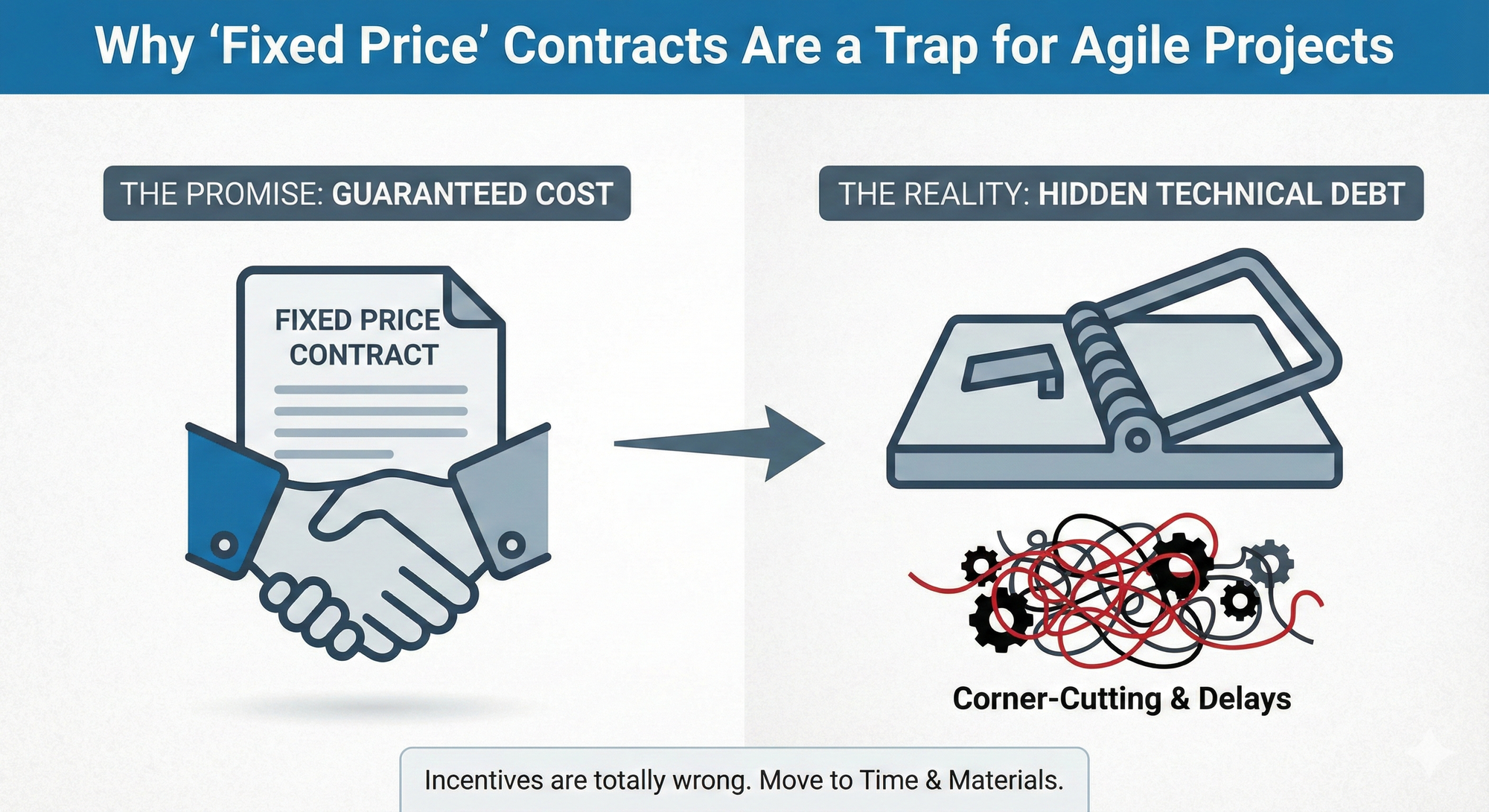
The "Fixed Price" Mirage: Why You’re Buying Technical Debt, Not Certainty
Your CFO loves fixed-price contracts. They fit perfectly into a Q3 budget spreadsheet. You know exactly what you are spending. You have a signed piece of paper promising a specific set of features on a specific date. It feels safe. It is actually the riskiest way to build software. In agile development, a fixed-price bid is a lie agreed upon by both parties. You pretend requirements won't change. The vendor pretends they know exactly how long complex engineering tasks will take. When reality
Read More